Understanding Poodle Coat Colors: Genetics, History, and What to Expect
Educating prospective puppy owners is one of the most important responsibilities of a quality breeder. Preparing families with accurate expectations leads to happier, long-term partnerships between owners and their dogs.
Coat color is often the first thing that catches a buyer’s eye. Poodles boast one of the widest varieties of shades and patterns in the canine world, making them visually stunning. However, while color is exciting, traits like temperament, drive, and trainability ultimately define your day-to-day experience. Prioritizing personality and lifestyle compatibility ensures a rewarding relationship—stunning coat color is simply a wonderful bonus!
Can you get your ideal coat color alongside a stellar temperament? Often, yes! Keep an open mind during your puppy search, prioritize disposition first, and you may very well land your dream color too.
A Brief History of Poodle Colors
Historical artwork from the 15th through 19th centuries regularly depicted Poodles in bi-color or "parti" coats (typically black and white). By the early 20th century, aesthetic trends shifted toward solid colors, leading to the deliberate selection against multi-colored coats in registration databases and breeding lines. Today, public preference has broadened once again, welcoming both solid and multi-colored Poodles into family homes and sporting arenas.
AKC Standards vs. Everyday Companions
AKC Conformation Ring: If you plan to compete in traditional AKC conformation shows (like Westminster), focus on solid-colored Poodles from show-focused lines. The AKC evaluates dogs strictly against a written breed standard where solids are preferred for conformation.
UKC Conformation: The United Kennel Club (UKC) offers dedicated conformation classes specifically for multi-colored Poodles.
Sports & Family Pets: For sports like Agility, Fast CAT, Obedience, and Rally—or for wonderful family pets—coat color or pattern plays no role. Your options are completely open.
AKC Recognized Solid Colors
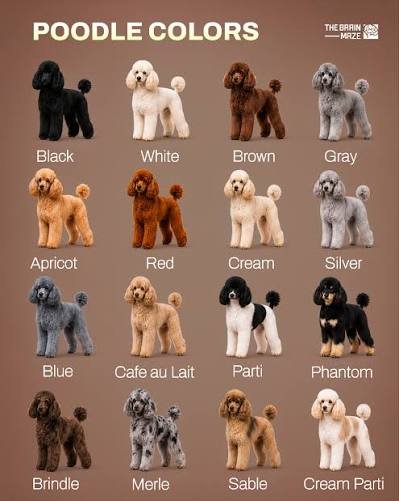
The American Kennel Club (AKC) official breed standard recognizes 11 solid coat colors for Poodles:
Black
Blue (a dark charcoal grey caused by progressive fading from black)
Silver (a bright, light grey fading from black early in life)
Brown
Cafe au Lait (a light tan/brown resulting from coat fading)
Silver Beige (a brown coat that fades to a pale silver-tan tone)
Cream
White
Apricot
Red
Gray
Important Notes on Solid Colors & Showing
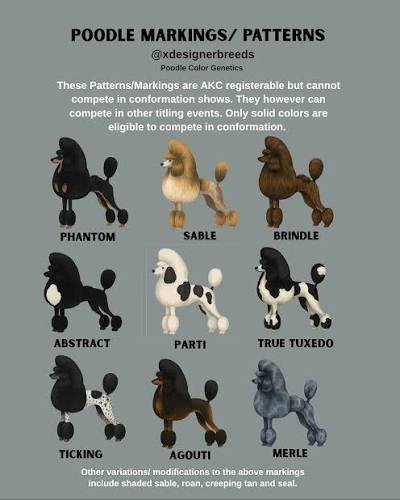
Show Ring Eligibility: Only solid-colored Poodles are eligible to compete in official AKC conformation show rings. Non-solid patterns (such as Parti, Phantom, or Merle) can still be registered with the AKC, but they are disqualified from conformation classes.
Progressive Fading: Many solid colors (like Blue, Silver, Cafe au Lait, and Silver Beige) are driven by a progressive graying gene mutation. Puppies are often born a darker shade (such as pure black or brown) and lighten significantly over their first 1 to 2 years of life.
Common Poodle Patterns & Markings
Parti: A predominantly white coat featuring distinct patches of any solid color (such as black or brown). Parti Poodles can also display phantom or merle patterning, and some develop "ticking" (small spots of color in the white areas) as they mature.
Abstract (Mismark): Characterized by small, isolated white patches, typically on the chest or paws. Genetically, an abstract Poodle carries a single copy of the parti gene.
Phantom: Features a primary base color with sharply defined accent markings above the eyes, on the sides of the muzzle, across the chest, under the tail, and on the lower legs.
Merle: A genetic pattern that lightens random sections of the coat. A single copy of the merle gene produces unique mottled effects (for example, black diluting into patches of gray, often called "blue merle").
Health Misconceptions: A dog carrying one copy of the merle gene carries no increased health risks compared to non-merle dogs. Health issues (such as vision or hearing impairment) typically arise only in "Double Merles"—dogs inheriting two copies of the gene from two merle parents. Responsible breeders never pair two merle dogs together.
Registration: Merles can be registered with the AKC as long as both parents are registered purebreds. While merles (and other non-solid patterns) cannot compete in AKC conformation rings, AKC registration itself serves as a pedigree tracking database, not a certification of show eligibility.
Coat Fading and Progressive Graying
Poodles naturally possess coat-fading genes that cause their color to lighten or clear as they move from puppyhood into adulthood:
Blue: Born jet black, clearing to a dark charcoal over the first 1–2 years (one copy of the fading gene).
Silver: Born black, rapidly lightening to silver within the first few months (two copies of the fading gene).
Silver Beige & Café au Lait: Brown puppies that lighten significantly as they mature due to fading genes.
Genetic mutations naturally influence coat variations over time. Recognized colors like silver and blue reflect how the standard has embraced these harmless genetic shifts.
Can DNA testing predict coat fading? Currently, no. While tests evaluate traits like "intensity" or "dilution," the specific gene responsible for progressive coat fading in Poodles has not yet been isolated on commercial panels.
Estimating adult color: To gauge how much a puppy's coat might lighten, examine the parents in person or via raw, unedited photos and videos taken in natural light once they are past 1.5 to 2 years of age. A puppy's coat is always at its richest intensity when young; adult coats often incorporate lighter "guard hairs" that soften the overall shade over time.
Final Thoughts
While color adds flair, a dog's character forms the foundation of your life together. Be cautious of photo filters or marketing claims that over-emphasize rare colors at the expense of sound health and temperament. Looking past the "eye candy" ensures you bring home a dog you'll love for a lifetime.