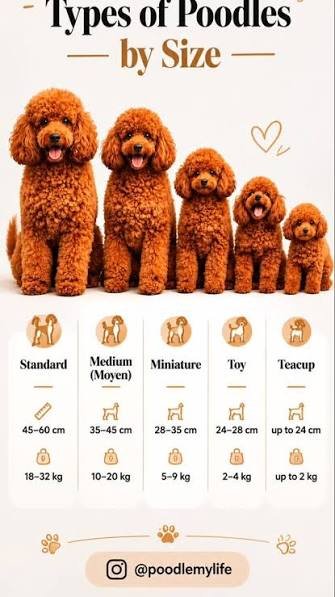
Official American Kennel Club (AKC) Poodle Sizes
The AKC officially recognizes three size categories for Poodles based on shoulder height:
Standard: Exceeds 15 inches tall.
Miniature: Measures 15 inches or under.
Toy: Measures 10 inches or under.
While standard poodles technically include any dog taller than 15 inches, most average around 40 to 70 pounds (females tending toward the lighter end and males toward the heavier end) and rarely land in the 16–20 inch range.
Understanding "Moyen" or "Klein" Poodles This leaves a distinct size gap between full-sized Standards and Miniatures. In European kennel clubs, this middle range is officially recognized as a "Klein" (Germany) or "Moyen" (France) Poodle.
No US Official Standard: The AKC and other major US registries do not formally recognize a medium-sized Poodle.
An Informal Term: In the United States, "Moyen" simply refers to a smaller-than-average Standard Poodle. Because there is no official sizing standard, the label is subjective and can vary from breeder to breeder.
How Breeders Create Medium Poodles Because American kennel clubs lack a medium classification, breeders often pair a Miniature (typically a male) with a Standard (typically a female) in what is called an intervariety breeding.
Purebred Status: The resulting litter consists of 100% purebred, registrable Poodles.
Varied Litter Sizes: Simple averages do not guarantee puppy sizes—crossing a 50-lb Standard with a 20-lb Miniature will not consistently yield 35-lb offspring. Due to genetic diversity, puppies in the same litter may mature to be small like the father, large like the mother, or anywhere in between.
Achieving Predictable Sizing: "Breeding True" To reliably predict size, a breeding line must "breed true," which requires consistent selection across multiple generations:
Initial Cross: An intervariety breeding is performed.
Selective Pairing: Only the offspring that naturally fall into the target size window (e.g., 18–20 inches and 30–35 pounds) are chosen for future breeding.
Multi-Generational Refinement: Continuing this selective process over 4 to 6 generations stabilizes the gene pool, significantly increasing the likelihood that future puppies will mature to the intended size.
Key Takeaways for Buyers
Check the Pedigree: Review the shoulder height and weight of a puppy’s parents and grandparents to better gauge expected adult size.
Size Contract Clauses: Because genetics involve multiple generations of influence, two similar-sized dogs can still produce offspring that are noticeably larger or smaller. Consequently, ethical breeders rarely guarantee exact adult sizes in purchase contracts.
Look Beyond Size: Responsible breeders prioritize health, temperament, and structure alongside size selection, rather than focusing solely on physical dimensions.